
Category: Psychotherapy

Can Online Therapy Be as Effective as In-Person?

Many people considering counselling ask the same question: “Can online therapy really work as well as meeting in person?”

It’s a fair question. For many people, therapy has traditionally been something you attend in a therapist’s office. Sitting in the same room can seem as though it would naturally create a deeper connection.

However, after several years of providing virtual counselling to clients across Alberta, I’ve found that online therapy can be just as effective for many people — and sometimes even more accessible.

What Actually Makes Therapy Effective?

Research consistently shows that the most important factors in successful therapy are not the room you sit in, but the relationship and the process. In my clinical experience, therapy tends to be most effective when several key elements are present:

  • A strong therapeutic relationship
  • Clients feel safe, understood, and respected
  • Consistency in attending sessions
  • The use of evidence-based therapeutic approaches
  • A client’s readiness and engagement in the process

These factors can develop just as naturally in an online session as they do in person.

Why Online Therapy Works Well for Many Midlife Women

Many of the women I work with are balancing multiple responsibilities at once, their careers, family life, supporting aging parents, and managing their own health and well-being. One of the biggest benefits clients mention about online therapy is convenience.

Virtual sessions eliminate travel time, which means:

  • No commuting across the city and in unpredictable traffic
  • No parking or travel costs
  • No rushing to make it to an appointment after work
  • Greater ability to keep sessions on time and consistent

Many clients also feel more comfortable talking from their own home, where they already feel safe. For women with full schedules, this can make it much easier to prioritize their own well-being without adding more stress to their day.

A Real-World Example

For example, I worked with a client who was a shift worker living outside Calgary. Driving to Calgary for therapy would have been unrealistic given her schedule.

Through online counselling, we were able to schedule sessions that worked around her shifts. She could log in from home without worrying about travel, time constraints, or even what she was wearing after a long workday.

Because location was no longer a barrier, she was able to receive consistent support while navigating important personal decisions in her life.

Virtual therapy also allows me to work with clients across Alberta, making counselling accessible even if they live outside Calgary.

Online therapy also increases access to care. Many people face barriers such as distance, busy schedules, mobility issues, or limited availability of therapists in their area. Virtual sessions remove many of these obstacles, allowing clients to connect with a qualified therapist from the comfort of their own home and access without the added stress of travel or scheduling constraints.

Common Concerns About Online Therapy

Before starting online therapy, many people share similar concerns:

  • concern about technical issues
  • privacy and confidentiality
  • whether sessions will feel too impersonal
  • Difficulty finding a quiet, distraction-free space from family and pets!
  • Feeling Zoom-fatigue post-pandemic while craving human interaction

These concerns are understandable. However, most clients find that once they begin, the experience feels far more natural than expected.
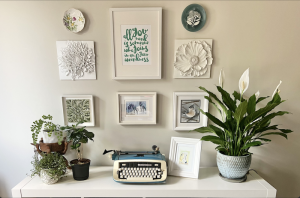
Virtual counselling officeHow I Create a Safe and Personal Online Therapy Space

Creating a safe and supportive therapeutic environment is just as important online as it is in person.

In my virtual practice, I focus on several things to ensure sessions feel comfortable and secure:

  • Using a secure, confidential platform
  • Reinforcing confidentiality from my private home office
  • Maintaining eye contact and attention to non-verbal cues
  • Creating a warm and welcoming office setup with good lighting
  • Offering the option of video or phone sessions

These small details help create a space where clients can feel relaxed, heard, and supported — even through a screen.

Is Online Therapy Right for You?

Online therapy can be an excellent option if you:

  • Have a busy schedule
  • Prefer the comfort of your own space
  • Live outside the city
  • Want to avoid travel time
  • Need greater flexibility around work or family demands

For many people, the convenience of virtual sessions makes it easier to stay consistent with therapy, which is one of the most important ingredient for meaningful change. What to expect on your first visit.

Final Thoughts

Therapy isn’t about the room, it’s about the relationship, the process, and the work you do together.

Whether sessions take place in an office or online, what matters most is having a space where you feel safe to explore your experiences, gain insight, and move toward a more fulfilling life. Here are 5 ways to get the most from your therapy sessions.

If you’re considering therapy and wondering whether online or in-person sessions might work best for you, you can learn more about my and book a free consultation.
Book a Consultation


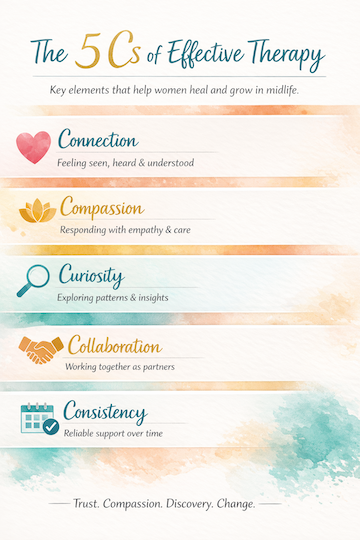
The 5 Cs of Effective Therapy

Many women come to counselling in midlife saying something similar:

“I don’t feel like myself anymore.”

For some, it’s the emotional weight of menopause, changing sleep, and nervous system dysregulation. For others, it’s accumulated stress, unresolved trauma, relationship changes, or a growing sense that something in life needs to shift.

Midlife is often a powerful turning point—but it can also feel confusing and overwhelming.

One question many women quietly ask before starting counselling is:
“What actually makes therapy effective?”

While there are many therapeutic techniques and approaches, meaningful change often comes from a few core elements that shape the counselling relationship and process.

I often think of these as the 5 Cs of Effective Therapy.

1. Connection: Feeling Truly Seen and Understood

Healing begins with connection.

In counselling, this means creating a space where you feel safe enough to talk openly about what you’re experiencing—without judgment or pressure to have everything figured out.

For many women in midlife, this may be the first time they’ve had a space that is fully theirs.

A strong therapeutic connection allows you to:

  • speak honestly about what you’re feeling

  • explore difficult emotions safely

  • begin making sense of experiences that may have been carried for years

When you feel understood, the nervous system can begin to settle—and that’s where meaningful reflection and change can start.

2. Compassion: Softening the Inner Critic

Many women in midlife carry a harsh internal voice:

“I should be handling this better.”
“Why can’t I just get over it?”
“Other people have it worse.”

Compassion in therapy helps gently challenge these beliefs.

Rather than focusing on what’s “wrong,” compassionate counselling helps you understand how your experiences, stress, and life transitions have shaped your current patterns.

This approach can be particularly powerful for women who have experienced:

Learning to relate to yourself with compassion can be one of the most transformative aspects of therapy.

3. Curiosity: Understanding Your Patterns

Therapy isn’t about analyzing you. It’s about exploring your experiences together with curiosity.

Curiosity allows us to look at patterns without judgment. For example:

  • Why do certain situations trigger anxiety or overwhelm?

  • Why does sleep become more difficult during stressful periods?

  • Why do old memories or emotions sometimes resurface in midlife?

Midlife often brings a natural period of reflection. Curiosity helps turn that reflection into understanding rather than self-criticism.

When we become curious about our reactions and experiences, we create space for new perspectives and healthier responses.

4. Collaboration: Working Together Toward Change

Effective counselling is not something that happens to you—it is something we build together.

Collaboration means:

  • setting meaningful goals

  • identifying strategies that feel realistic for your life

  • adjusting the process based on what is or isn’t working

Some women come to counselling wanting practical tools for sleep or anxiety. Others want to process deeper emotional experiences or trauma.

Both are valid, and therapy works best when it reflects your needs, pace, and priorities.

5. Consistency: Creating Space for Lasting Change

Meaningful change rarely happens overnight.

Consistency in therapy allows you to gradually:

  • build awareness of patterns

  • practise new skills

  • process experiences safely

  • strengthen emotional resilience

For many women in midlife—who have spent decades supporting others—regular counselling can become a grounding space to pause, reflect, and reconnect with themselves.

Over time, this consistent support often leads to greater clarity, emotional balance, and a renewed sense of direction.

Midlife Can Be a Turning Point

Midlife is often portrayed as a crisis. In reality, it can also be a powerful opportunity for growth and renewal.

Counselling offers a space to:

With the right support, midlife can become a time of greater self-understanding, resilience, and meaningful change.


A Gentle Invitation

If you’re feeling overwhelmed, stuck, or simply not like yourself lately, counselling may provide the space you need to reflect and move forward with greater clarity.

You don’t have to navigate this stage of life alone.

What to expect from your first visit.

Reclaim joy, clarity, and resilience with ART

All PostsAccelerated Resolution Therapy in Calgary

Accelerated Resolution Therapy (ART) is a gentle, evidence-based approach that supports you in releasing troubling thoughts, images, or body sensations by replacing them with ones that feel more positive and empowering. I offer this process in a compassionate and secure environment — without requiring you to talk about the full details of your trauma. This is done quickly, most often within one session! Once the negative images have been replaced by positive ones, the triggers will be gone. Nightmares and repeated intrusive thoughts will stop.

One of the unique benefits of ART is how quickly it can create change. Throughout the process, you remain in control, while moving past what feels stuck and have you leave feeling renewed, peaceful, and positive.

Trauma healing with Accelerated Resolution Therapy CalgaryART is also unique in that it combines the enormous power of eye movements, to allow voluntary changes in the client’s mind, with well-established therapies like Gestalt, Psychodynamic Therapy and Guided Imagery. Eye movements are calming and therapeutic have  been shown to produce theta waves in the brain. Theta waves have been connected to creativity, intuition,  and daydreaming. These brain waves are often present during meditative states.

Although some traumatic experiences such as rape, combat or loss of a loved one can be very painful to visualize, early in the ART session the client has already rapidly moved beyond the place where they are stuck in these past experiences and is making positive changes of their choice. ART sessions are calming and very often joyful, especially at the end, for both the client and the therapist.

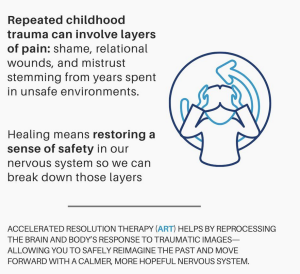
Repeated childhood trauma can involve layers of pain: shame, relational wounds, and mistrust stemming from years spend in unsafe environments.  Healing means restoring a sense of safety in our nervous system so we can break down those layers.

Here are some issues that have been quickly and effectively treated by ART:

  • Anxiety
  • Depression
  • Phobias
  • Panic Attacks
  • Obsessive-Compulsive Disorder (OCD)
  • Post Traumatic Stress (PTS)
  • Addictions/ Substance Abuse
  • Performance Anxiety
  • Family Issues
  • Victimization/Poor Self Image
  • Victimization/Sexual Abuse
  • Relationship Issues/Infidelity
  • Codependency
  • Grief
  • Job-Related Stress
  • Pain Management
  • Memory Enhancement
  • Dyslexia Anxiety

For many, the relief is not only fast but also life-changing. ART is helping people move beyond their struggles and reclaim joy, clarity, and resilience in their daily lives. Healing doesn’t always have to take years—sometimes, lasting change is possible in just a single session. Learn more here.

Book a Consultation

How ART is different from EMDR

ART is a highly directive, scripted approach where the therapist actively guides clients to replace distressing images and sensations, often achieving resolution in a single session. EMDR is a client-led, free-associative process that focuses on cognitions, and typically requires multiple sessions, with the therapist intervening only when processing becomes blocked.

What is Mindfulness-Based Stress Reduction?

MBSR in Calgary to Support Your Mental Health

by Sandra Wiebe

In the midst of a busy life, juggling relationships, career changes, caregiving, or even just the quiet shift into a new chapter it’s not uncommon to feel overwhelmed, anxious, or disconnected. For many midlife women, stress becomes a near-constant companion. But what if there was a gentle, evidence-based way to relate to stress differently, with awareness, compassion, and intention? Enter Mindfulness-Based Stress Reduction (MBSR).

Originally developed in the 1970s by Dr. Jon Kabat-Zinn, MBSR teaches participants how to use mindfulness to manage stress, pain, and illness, encourages moment-to-moment awareness, noticing your thoughts, feelings, and body sensations without judgment.

Present moment awareness. Calgary Therapist

Being present, in the moment, taking in what is here and now is mindfulness.

It’s not about clearing your mind or achieving a state of bliss. Rather, it’s about learning to be with whatever is present, with greater clarity and calm.


Why It Matters in Midlife

The midlife season is often one of reflection and transition. It can bring hormonal shifts, changing family roles, grief, health issues, or questions about purpose and identity. These layers of stress can quietly build up, impacting your mental well-being and sense of self. MBSR offers a way to pause, breathe, and come home to yourself.

Through regular mindfulness practice, many women report:

  • Feeling less reactive and more grounded
  • Improved sleep and concentration
  • Greater self-compassion and emotional resilience
  • Relief from anxiety and low mood
  • A renewed connection with their body and inner wisdom

The Science Behind It

MBSR has been widely studied, and the research is encouraging. Studies show that participants in MBSR programs often experience reduced symptoms of depression and anxiety, improved emotional regulation, and increased grey matter in brain regions linked to learning, memory, and emotional balance.

Put simply, mindfulness helps rewire the brain,  creating new patterns that support peace, presence, and mental flexibility.

A Simple Example

Imagine you’re having a difficult day, perhaps you’re feeling criticized, overlooked, or stretched too thin. Instead of spiralling into harsh self-talk or numbing distractions, mindfulness invites a pause. You might notice the tightness in your chest, the swirl of thoughts, the urge to react. With practice, you learn to soften, breathe, and choose a kinder response. That’s the heart of MBSR, not avoiding stress, but transforming your relationship with it.

You deserve tools that help you not just cope with life’s challenges, but meet them with strength and softness. Mindfulness-Based Stress Reduction isn’t a quick fix,  it’s a compassionate pathway back to yourself.

If you’re curious about integrating mindfulness into your healing journey, feel free to reach out , I’d be honoured to walk alongside you. Learn about how to get the most from your counselling session.

Book a Free Consultation

Sidebar