
Midlife can bring a period of significant change, reflection and, at times, uncertainty. It is often a stage of life when the roles, relationships and expectations that once defined us begin to shift. Children leave home, careers evolve, relationships change, parents age, and menopause can bring physical and emotional changes that challenge our sense of identity. In my work as a therapist, I often see how these transitions can leave women questioning who they are, what they want and what comes next.
You may find yourself wondering, Who am I now? What matters to me at this stage of life? And how do I move forward when the life I’ve built no longer feels quite right?
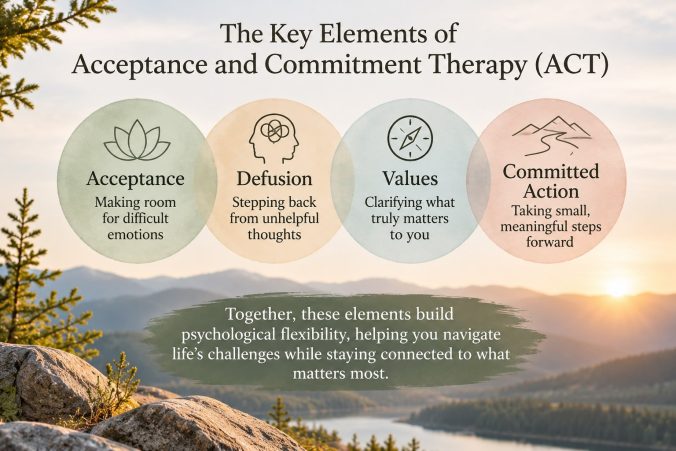
Acceptance and Commitment Therapy (ACT) offers a thoughtful approach to navigating these questions. Developed by psychologist Dr. Steven C. Hayes and his colleagues, ACT is an evidence-based form of psychotherapy that helps us change our relationship with difficult thoughts and emotions. Rather than trying to eliminate discomfort, the goal is to learn how to make room for our experiences while continuing to move towards a life that feels meaningful.
Making room for what you feel
A central concept in ACT is psychological flexibility. In everyday terms, this means developing the ability to be present with what is happening, recognize your thoughts and feelings without becoming consumed by them, and make choices that reflect the person you want to be.
Consider how easily certain thoughts can become part of our identity. “I’m not good enough.” “It’s too late to start over.” “I should be further ahead in my life.” When these thoughts become familiar, we can begin to treat them as facts. They influence our decisions, limit our choices and sometimes keep us from pursuing things that matter to us.
ACT introduces a skill called cognitive defusion, which helps us step back from our thoughts and recognize that a thought is not necessarily the truth. There is a difference between saying, “I’m not good enough” and recognizing, “I’m having the thought that I’m not good enough.” That small shift can create room for a different response. Rather than automatically believing the thought, we can decide how much importance to give it.
Acceptance is another important part of this approach. It doesn’t mean liking what has happened, giving up or tolerating situations that are unhealthy. It means learning to experience difficult emotions without constantly fighting, avoiding or trying to control them. Anxiety, grief, sadness and uncertainty are part of being human. We don’t have to wait for them to disappear before we start living.
Reconnecting with what matters
One of the aspects of ACT I find particularly valuable in midlife is its emphasis on personal values. Values are the qualities and principles that give our lives meaning. They might include connection, independence, courage, creativity, compassion, adventure or authenticity.
Over time, our values can become buried beneath responsibilities, expectations and the needs of others. Midlife can be an opportunity to pause and consider whether the way we are living reflects what is genuinely important to us today.
What do you want more of in your life? What have you been putting off? Where have you lost your voice? What would it look like to make decisions based on your values rather than guilt, fear or other people’s expectations?
ACT helps translate these reflections into action through what is called committed action. This means taking small, intentional steps towards the life you want, even when uncertainty or self-doubt are present. You don’t have to feel confident before setting a boundary, making a change or trying something new. You simply need to be willing to take the next step.
Moving forward with intention
ACT isn’t about positive thinking or convincing yourself that everything is fine. It is about developing the flexibility to experience the full range of human emotions while choosing how you want to respond to life.
In my counselling work, I see midlife as an opportunity to examine the stories (and traumas) we have carried, reconnect with our values and reconsider what we want the next chapter to look like. We cannot always change our circumstances or undo our experiences, but we can develop a different relationship with them.
You don’t need to return to the person you were before. You have grown, experienced, learned and changed. The opportunity now is to discover who you are becoming and make choices that reflect that person.
You don’t need to have everything figured out. You just need to begin moving in a direction that feels true to you.
